Product Design & Material Choices
Based on our value-chain assessment, product energy use, materials and end-of-life are key focus areas. We integrate selected energy, material and compliance requirements into product development and packaging decisions.
Design for Energy Efficiency, Repairability and Material Use
We apply product design requirements related to energy efficiency, repairability and material information. We support repair and maintenance where spare parts and service routes are available.
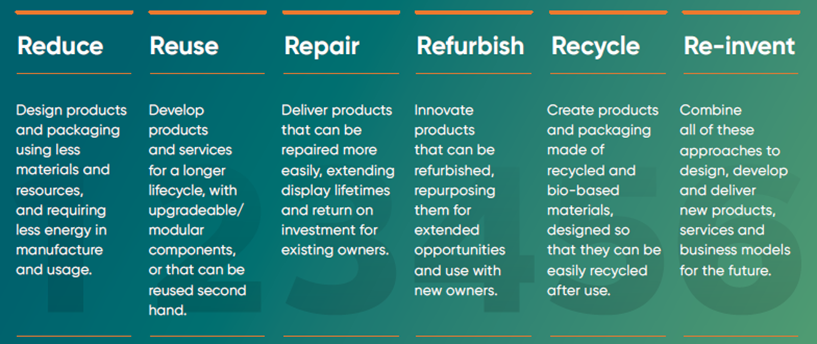
We distinguish six principles that help to reduce packaging volume”, “increase recycled plastic content”, “improve energy label performance” where evidenced.
(see Figure 1)
Materials & Packaging
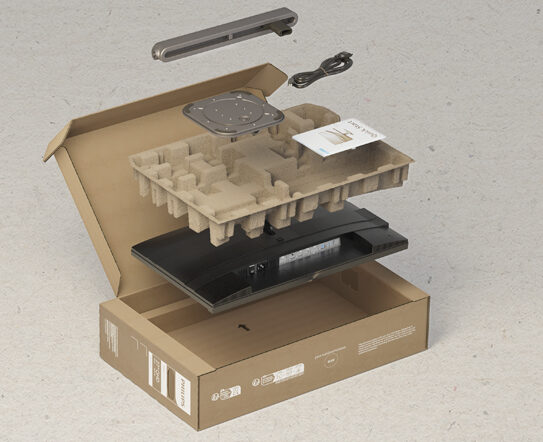
Selected models use packaging designed with recyclable materials and FSC-certified paper-based components. Recyclability depends on local facilities. In 2024, 13% more monitor models qualified as sustainable compared to the previous year, reflecting our ongoing progress in responsible innovation.
Models 24B2G5200 and 27B2G5500
These models include energy-saving features and published energy consumption data in their EU energy label documentation:
- Energy-efficient operation
Equipped with PowerSensor and LightSensor technology, they reduce power usage by up to 80%, adapting to user presence and ambient lighting. A 0-watt hard switch ensures zero energy consumption when turned off. - Sustainable materials
Both models use 85% post-consumer recycled (PCR) plastics and 5% ocean-bound plastic, and are packaged in 100% recyclable, FSC-certified materials. - Certified green
Rated TCO Certified 9.0 & TCO Certified 10 and EPEAT Gold, these monitors meet leading environmental standards. - User-friendly design
Featuring LowBlue Mode to support user eye comfort and well-being.
🔗 Discover our full range of low impact monitors
Tools & Transparency
To empower customers in making more sustainable choices, we provide:
- A Product Sustainability Matrix highlighting key eco-features across our monitor range
A Product Carbon Footprint (PCF) Information Sheet for each monitor (where available), showing the estimated carbon emissions across its life cycle. These are listed in the table below, with direct links to each PCF. (see Table 1)
A Sustainability Calculator to estimate energy savings and emissions reductions.
A Product Carbon Footprint (PCF) Information Sheet for each monitor (where available), showing the estimated carbon emissions across its life cycle. These are listed in the table below, with direct links to each PCF. (see Table 1)
Model-level documentation provides product-specific repair, energy and material information:
More on corporate
social responsibility